

Brenau University photo by Jerrye & Roy Klotz MD, CC BY-SA 3.0
Roofing in Gainesville, GA
Gainesville is where we are based, so this is the one place we are not describing from a distance. It is also the place where the difference between a mailing address and a city limit matters most: about 140,000 people have a Gainesville address, and only around 45,000 of them live inside the city. Which side of that line your house sits on decides who permits your roof.
- Free inspection, no obligation
- Financing available through Wisetack
- 10, 25 & 50-yr workmanship warranties
- Crews working in Gainesville
- 5.0 on Google10 reviews
- 10, 25 & 50-yearworkmanship warranty tiers
- Limited lifetimeCertainTeed shingle warranty
- GAF Certified™residential roofing contractor
- ShingleMaster™CertainTeed credentialed
- Financingavailable on replacements
from 10 reviews on Google
“Professional, attentive, installed the new roof and cleaned up like they had not even been there. On site manager explained what they were doing every step of the way. The job was done quickly and efficiently.”
“The team was friendly, professional, and took the time to answer all my questions. They showed up when they said they would and completed the job on schedule.”
Financing
Pay over time, not all at once.
Most people do not plan for a roof. We have partnered with Wisetack so the decision is about what your home needs, not about what is in your account this month.
0% APR available up to 24 months for eligible customers
Up to $65,000
Wisetack finances projects up to $65,000, which covers a complete replacement on essentially any home in our service area.
Terms from 3 to 120 months
APRs run from 0 to 35.9% depending on the amount and your credit. No hidden fees and no compounding interest.
Checking does not affect your credit
Prequalifying takes about a minute and runs a soft check, so you can see your real terms before deciding anything.
All financing is subject to credit approval. Your terms may vary. Payment options through Wisetack are provided by our lending partners. For example, a $5,500 purchase could cost $253.54 per month for 24 months, based on a 9.9% APR, or $1,833.33 per month for 3 months, based on a 0% APR. Offers range from 0 to 35.9% APR based on amount requested and creditworthiness. Not all merchants and lending partners participate in 0% interest programs. Terms range from 3 - 120 months and may vary based on merchant, lending partner, or transaction size. State interest rate caps may apply. No prepaid finance charges or participation fees. See additional terms at wisetack.com/faqs.
The roofs of Gainesville, by the numbers
US Census figures for Gainesville itself, not Hall County.
- Median year built
- 1994
- Homes in the city
- 18,001
- Built before 1980
- 29%
- Built since 2000
- 44%
Gainesville is the one city we serve where the city numbers actively mislead about the roofing market. Inside the limits, only 39% of occupied homes are owner-occupied and fewer than half of all units are single-family detached, roughly 8,000 houses. Step outside into unincorporated Hall County and it is 69% owner-occupied and 72% detached. The median Gainesville home dates to 1994, which puts a large share of single-family roofs past the 25-to-30-year mark, but the bulk of the detached housing we actually work on has a Gainesville address without being in the city.
A Gainesville address is usually not the City of Gainesville
Roughly 140,000 people have a Gainesville mailing address. About 45,000 live inside the city limits. The other two-thirds are in unincorporated Hall County, and the two are separate permitting authorities that do not agree about roofs. The City of Gainesville lists re-roofing and roofing repairs as requiring a building permit. Hall County's own FAQ says that stripping old shingles and replacing them with new shingles or metal needs no permit, while the county's building permit page lists shingles-to-metal as requiring one. We confirm which authority governs your specific address before we file anything, because guessing is how a job gets stopped halfway.
Two historic districts, and the roof rule is unusually sharp
Gainesville has two local historic districts, Green Street and the Ridgewood neighborhood, plus two individual landmarks. In them the rule has no middle ground. Replacing asphalt shingles with asphalt shingles is ordinary maintenance and needs no Certificate of Appropriateness at all. Change the material, though, and it becomes major work requiring a full Historic Preservation Commission hearing: asphalt to metal, or an original wood shake or slate roof to asphalt. There is no staff-level approval in between, which is different from how Decatur handles the same decision. The Commission has 45 days to act on a complete application, and if it does not act the application is approved.
Downtown is not a regulated district
The Gainesville Commercial district downtown is on the National Register, and that is all it is. National Register listing places no restriction on a private owner using private money, Georgia's own preservation office puts it as a National Register district identifies, while a local district protects. A local downtown district appears in the city's design guidelines only as a proposal. So if you own downtown, the historic-district review step people assume applies to you does not.
Lake Lanier is actually inside the city limits
Unlike most places that claim it, Gainesville genuinely holds Lake Lanier water, a bit over five percent of the city is water, and the overwhelming majority of that is Lanier. Downtown sits about a mile and a quarter from the nearest shoreline at Longwood Park. Hall County holds around 460 of the lake's 752 shoreline miles, more than any other county. For a roof that means sustained humidity: algae streaking on shaded north-facing slopes, and less shelter from wind coming across open water. We install algae-resistant shingles as standard here rather than selling them as an upgrade. One thing lakefront owners are often surprised by: the Army Corps flowage easement runs up to 1,085 feet of elevation, so Corps land can begin only a short way behind the house, and tree or limb work on it is a Corps matter rather than a city one.
Your own trees are your business. The street trees are not
Gainesville's tree protection rules exempt property already occupied by an owner-occupied single-family home, so for most homeowners there is no city tree permit involved in clearing a limb over the roof. Two things survive that exemption. Trees in the public right-of-way stay protected and need authorisation from the city's public works director before anyone touches them, and the exemption does not extend to rentals, duplexes or anything non-residential. Worth knowing that where a permit is needed, the city waives it for trees a qualified professional certifies as dead, diseased, or damaged by lightning, wind or ice to the point of endangering safety, which covers most of what we find after a storm.
Thirty years of storm data, and what it actually says
Gainesville has the tornado history, 6 April 1936 remains the fifth deadliest tornado in United States history at 203 lives, and the Cooper Pants Factory that day still carries the highest death toll of any single building in any American tornado. A second Gainesville tornado in June 1903 ranks seventeenth. But the everyday risk shows up in the thirty-year record. Hall County has logged over a hundred hail events since 1996, more than fifty of them at an inch or larger, which is roughly where hail starts taking granules off asphalt shingles. Thunderstorm wind events run higher still. The worst measured about 105 mph at Flowery Branch in April 2007, and the National Weather Service survey recorded at least thirty-five homes with roof and siding damage from that one storm. On 7 June 2025 a damage swath crossed central Hall County through Gainesville with gusts surveyed above 80 mph, and in January 2026 a quarter to a half inch of ice brought down trees across the county.
Gainesville writes roofing rules into the city code
Most places we work leave roofing material to the manufacturer and the HOA. Gainesville does not. For detached single-family homes the city code sets a minimum roof pitch of 3:12, requires a minimum twelve-inch overhang, and lists what may cover any roof surface exposed to view, asphalt or fibreglass shingles, wood shakes or shingles, clay tile, slate, standing-seam metal, or similar. If you are in the Gateway Corridor Overlay there is a further rule: metal and tin roofs are not permitted at all except standing seam, and even then it cannot reflect more light than your siding. These apply citywide, not only in the historic districts, and they are the sort of thing that turns into a failed inspection rather than a conversation.
Two layers is the limit, and Georgia updated the code in 2026
Georgia moved to the 2024 residential and building codes on 1 January 2026, and the state amendments leave the roofing chapter alone, so the model rules govern directly. The practical one: you cannot lay a new roof over an existing roof where two or more layers are already there. That is a tear-off, not a recover. If a previous contractor shingled over an old roof to save money, that decision is now yours to pay for, and it is one of the things we check on the inspection before quoting rather than discovering it once the crew is on site.
Housing and population figures: US Census Bureau, American Community Survey 2020–2024 five-year estimates, at place level for Gainesville city rather than Hall County. Historic district status: National Park Service Certified Local Government database and the city’s own ordinance. Local historic designation and National Register listing are different things, and only local designation affects roofing choices.
Recent work across North Georgia
Real jobs, photographed on site. No stock photography.
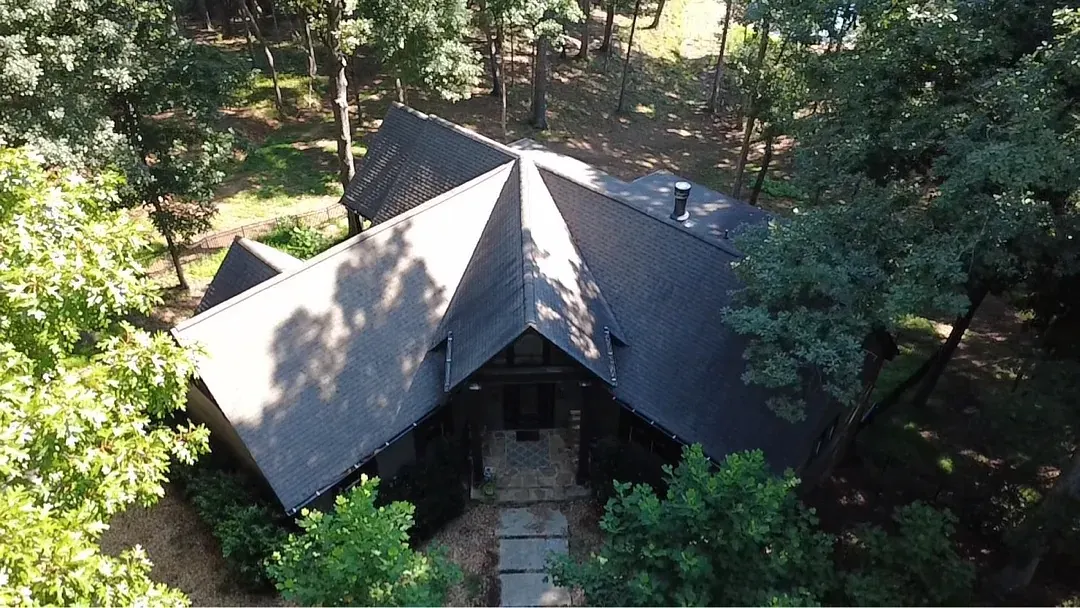
Before 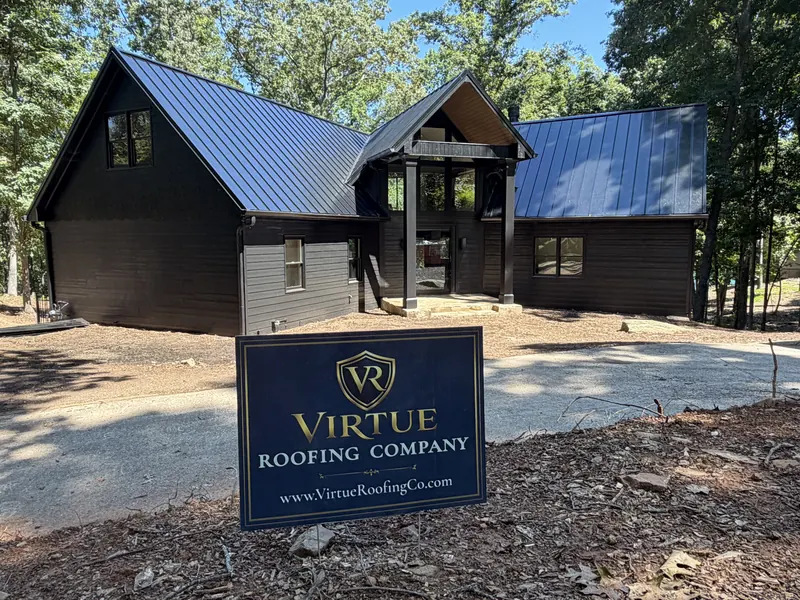
After Standing seam metal roof
Black standing seam, concealed fasteners
The original shingle roof came off, new underlayment went down, and the panels were formed on site to the length of each run.
Watch this job in 60 seconds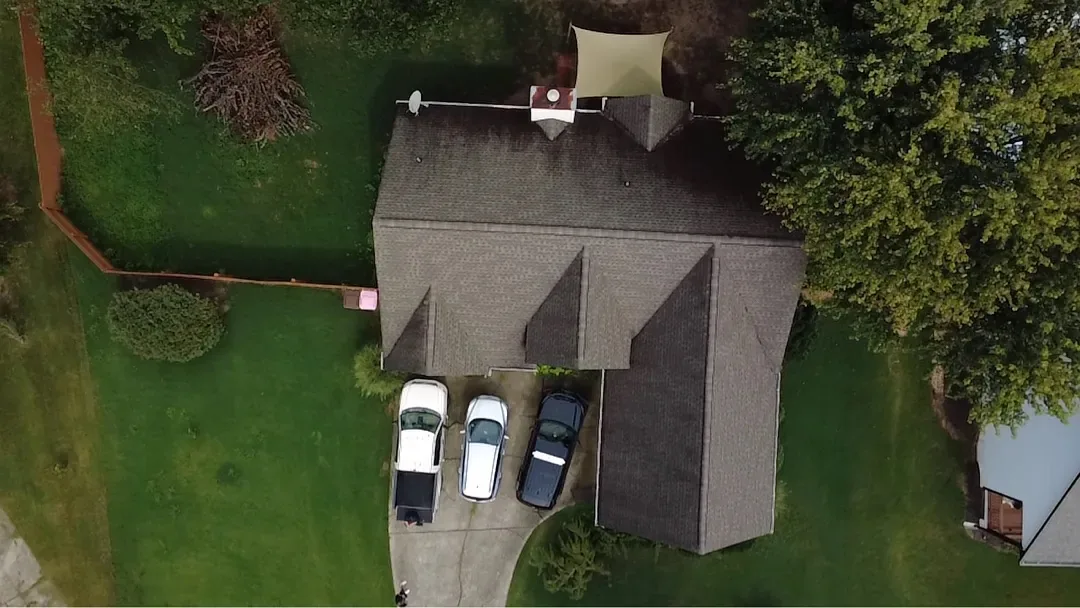
Before 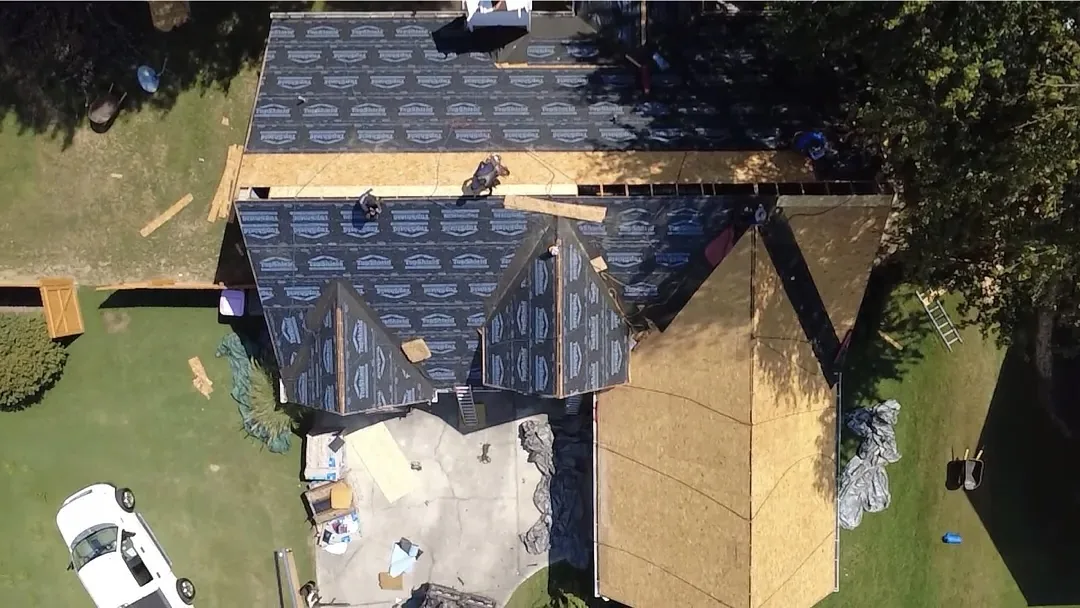
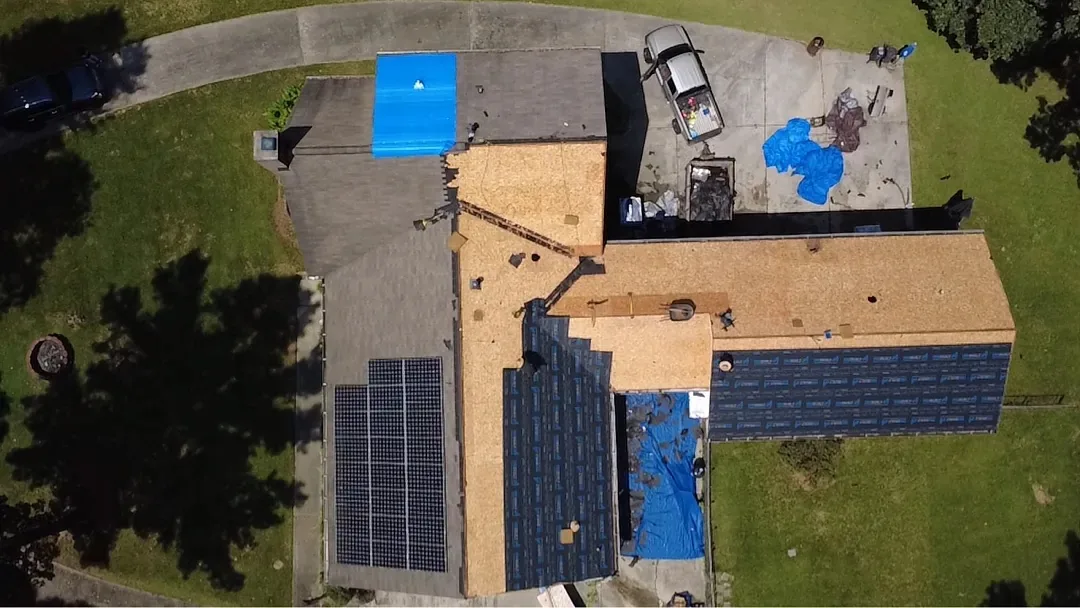
During 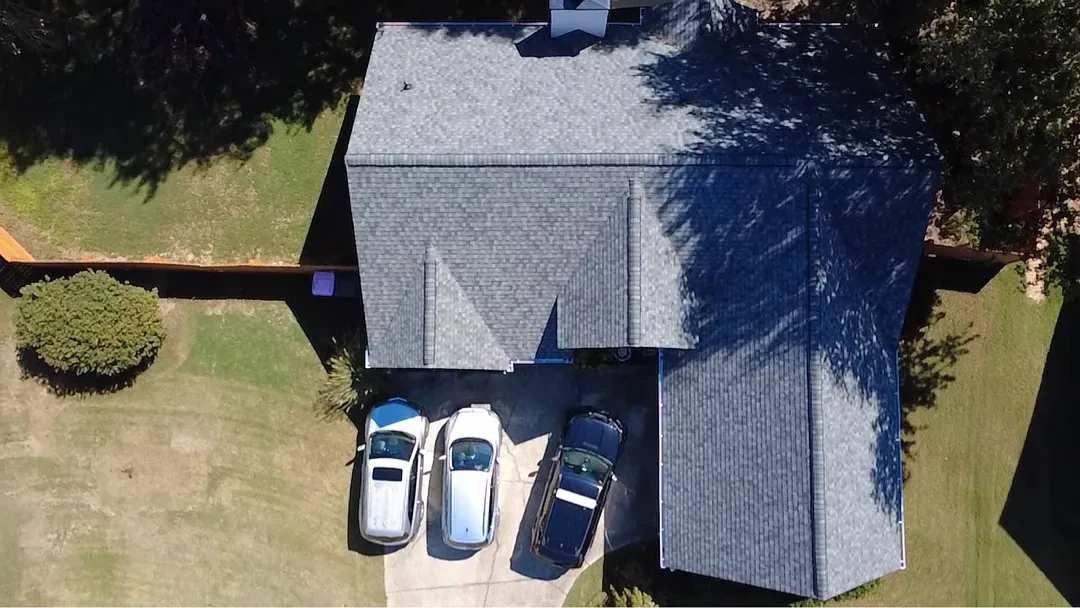
After Roof replacement
CertainTeed Landmark, Georgetown Gray
One house from the same angle: the old roof, the deck and underlayment stage, and the finished shingles.
During 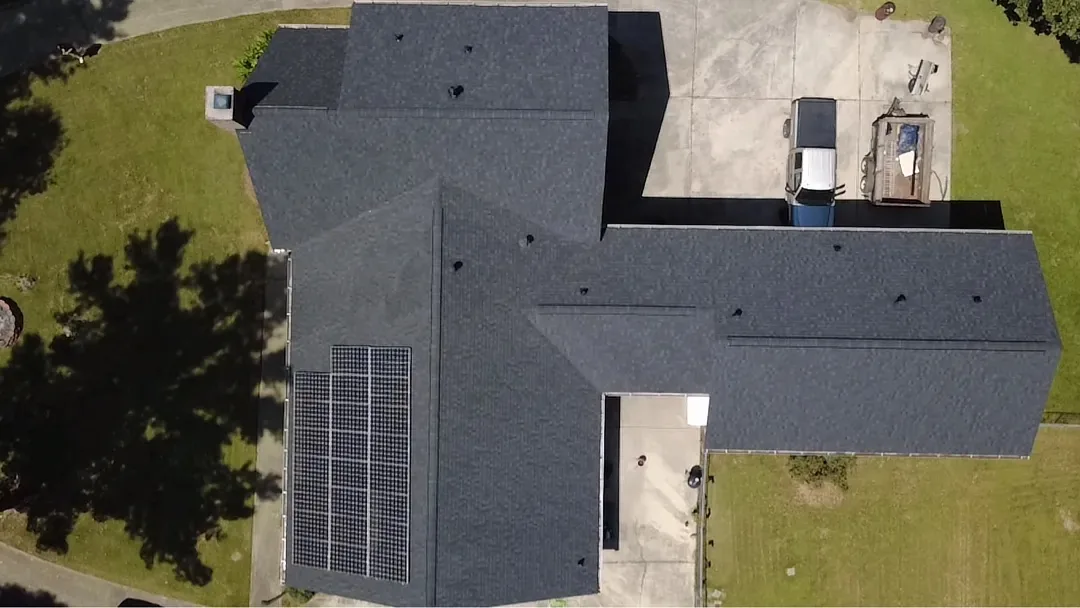
After 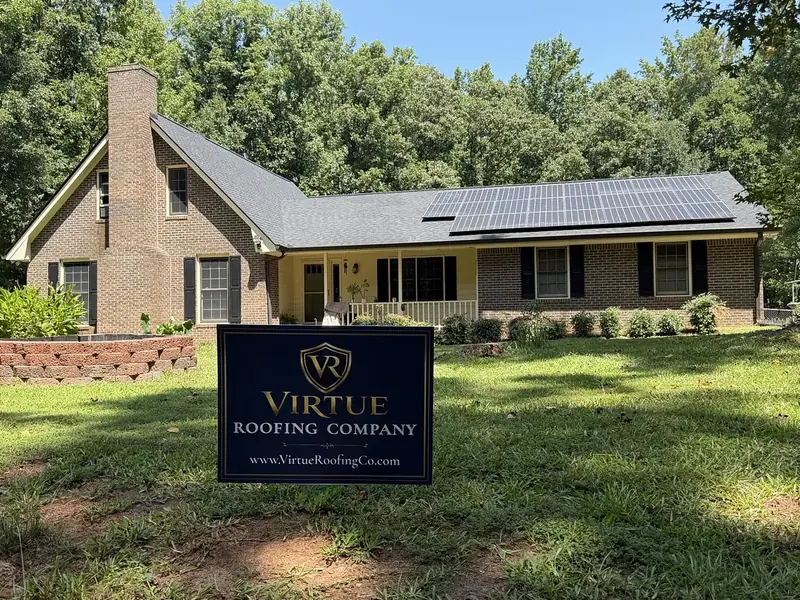
After Roof replacement with solar panels
CertainTeed Landmark, Pewter
A replacement on a home with a solar array. The panels were removed and reinstalled as part of the job.

Mid tear-off, down to the deck so it can be inspected. Pool, patio and beds tarped before a single shingle came off. 
The same roof finished. Continuous ridge vent along the ridges and a new boot at every penetration. 
Rotten decking does not show itself until the roof is open. Here it came off to the rafters and went back as new sheathing. 
Finished replacement on a heavily wooded lot, where overhang and shade are hard on a roof. 
New chimney crown and cap, with counterflashing let into the brick rather than smeared over it. 
Replacement chase cover and cap. A rusted-through cover drops water straight down the inside of the chase. 
Mid tear-off. Decking exposed and inspected before anything new went down. 
The same roof finished, and the yard cleared. 
Completed architectural shingle system, ridge, valleys and new pipe boots. 
Ranch replacement with new flashing at every penetration. 
Seamless gutter and downspout, hung on sound fascia and draining clear of the foundation.
What a roof replacement costs in Gainesville, GA
Our installed rates, priced the way roofers price: by the roofing square. Every figure includes complete tear-off, disposal and cleanup.
Installed, per roofing square
$400 to $600
Where you land in that range depends on which warranty option you choose. The differences are in the underlayment, the ice-and-water membrane, the pipe boots, the flashings and the length of the workmanship warranty.
In roofing, one "square" means 100 square feet of roof surface. Contractors price and order material by the square, so a quote priced per square is a quote in the trade's own unit.
Rates cover CertainTeed asphalt shingle systems and were last reviewed in October 2026. Metal runs on its own per-square rates, which the calculator quotes. Tile and other specialty systems are quoted in person. sheet in your written proposal.
Roofing in Gainesville: common questions
Do you actually work in Gainesville?
Yes. Gainesville sits in Hall County, which is one of the six counties we cover, and we have crews working there rather than sending teams in from elsewhere. Inspections and written quotes are free.
How old are most roofs in Gainesville?
The median Gainesville home was built in 1994. 29% of the city's 18,001 homes predate 1980 and 44% were built in 2000 or later. Gainesville is the one city we serve where the city numbers actively mislead about the roofing market. Inside the limits, only 39% of occupied homes are owner-occupied and fewer than half of all units are single-family detached, roughly 8,000 houses. Step outside into unincorporated Hall County and it is 69% owner-occupied and 72% detached. The median Gainesville home dates to 1994, which puts a large share of single-family roofs past the 25-to-30-year mark, but the bulk of the detached housing we actually work on has a Gainesville address without being in the city.
What does a roof replacement cost in Gainesville?
It depends on the size and pitch of the roof, how many layers come off, the condition of the decking underneath, and which of our three systems you choose. We quote Signature, Gold and Platinum, all carrying the same CertainTeed limited lifetime manufacturer warranty on the shingles, differing in components and in whether our workmanship warranty runs 10, 25 or 50 years. Every proposal is itemized so you can compare it line for line. The inspection and the written quote cost nothing.
Do I need a permit to replace a roof in Gainesville?
It depends on whether you are actually in the city, and most Gainesville addresses are not. The City of Gainesville lists re-roofing and roofing repairs among the work that requires a building permit. Unincorporated Hall County is less clear-cut: the county's FAQ says stripping old shingles and replacing them with shingles or metal needs no permit, while the county's own building permit page lists shingles-to-metal as requiring one. Since roughly two-thirds of people with a Gainesville mailing address live in unincorporated Hall County, this is worth settling before work starts rather than after. We confirm which authority governs your address and handle the filing either way.
Do I need historic approval to re-roof in Gainesville?
Only if you are in one of the two local historic districts (Green Street or the Ridgewood neighborhood), or own one of the two individual landmarks. There the rule is unusually clean: replacing asphalt shingles with asphalt shingles is ordinary maintenance and needs no Certificate of Appropriateness. Changing the material is major work and needs a full Historic Preservation Commission hearing, whether that is asphalt to metal or an original shake or slate roof to asphalt. There is no staff-level option in between. Being in a National Register district, including the whole downtown commercial district, carries no such requirement at all for a private owner.
Also across Hall County
Oakwood · Flowery Branch · Lula · Clermont · Gillsville · Murrayville · Chestnut Mountain
Hall County roofing servicesFree inspection, written quote, and an honest answer about whether you need work at all.